Deep Time, Hidden Clues: How Rocks Record Earth’s Most Powerful Processes
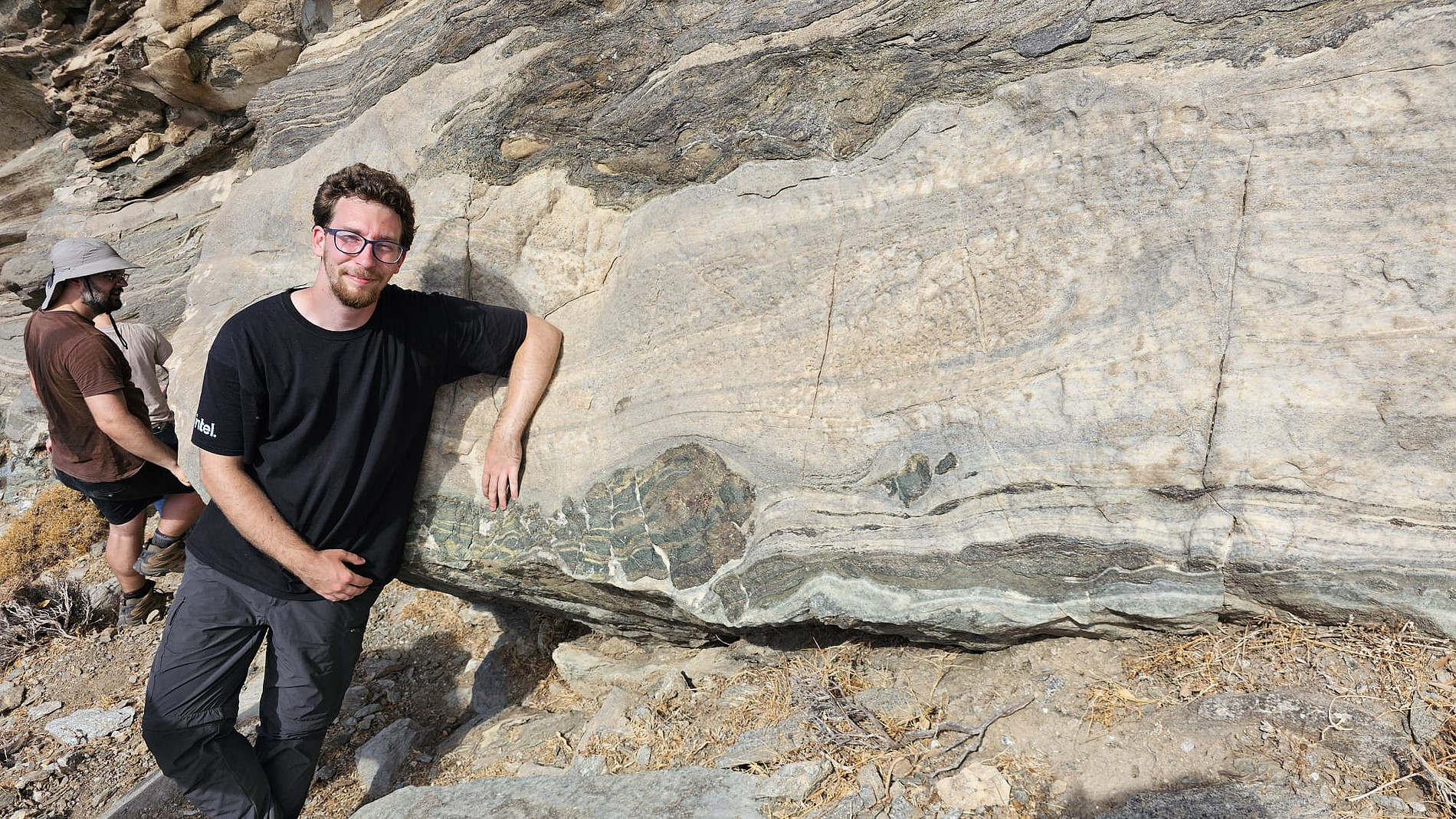
Earth is a dynamic planet, constantly reshaped by dramatic collisions between tectonic plates, causing major earthquakes and other natural hazards that directly influence human lives. However, much of Earth’s most dramatic activity happens far beneath our feet, in places we can never directly observe. One of Earth’s most dynamic settings is a subduction zone—where one tectonic plate sinks beneath another into the mantle. Yet the rocks that hold clues to what happens there are only revealed when parts of these deep zones return to the surface millions of years later.
My research focuses on understanding how fluids and chemical reactions reshape rocks as they are dragged deep into subduction zones and later exhumed. These reactions can weaken or strengthen the rocks along plate boundaries, influencing where major earthquakes occur. In the Greek Cyclades, slices of ancient subduction zones are now exposed at the surface, offering a rare archive of what happens 40–60 km underground. I study minerals that formed during this journey, with a special focus on a group of minerals called epidotes, to uncover when fluids moved through these rocks and where those fluids came from—key information for reconstructing the mechanical evolution of subduction zones.
Together, this work sheds new light on how rocks record the hidden life of subduction zones—from deep burial to their return to the surface—and pushes the boundaries of how minerals can be used to read Earth’s history. Beyond this project, I’m also involved in several international projects that explore the chemistry and evolution of rocks and minerals across a wide range of geological settings.
Epidote supergroup geochronology
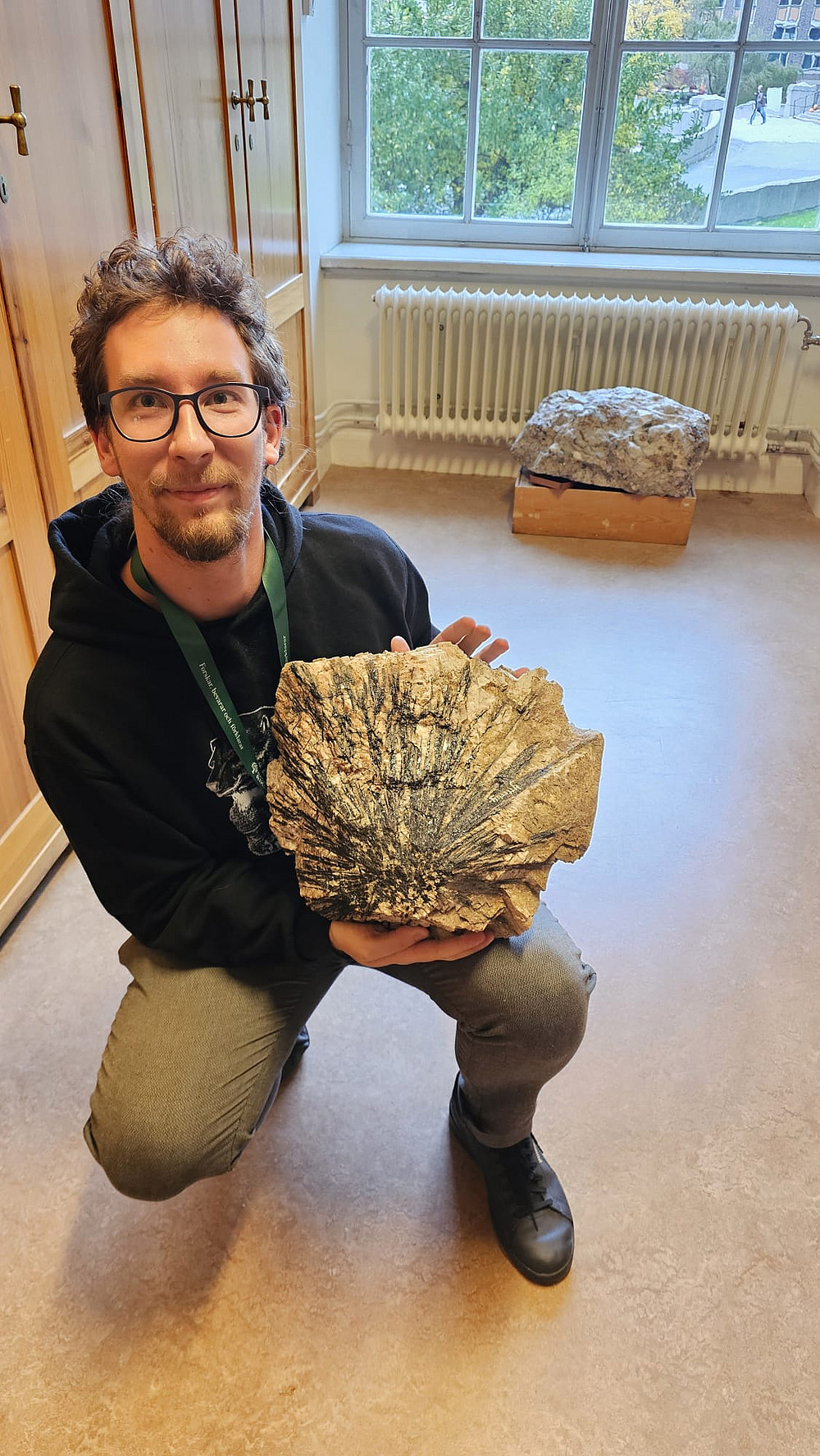
A major part of my doctoral project centres on a remarkable family of minerals called the epidote supergroup. Epidotes grow in a wide range of metamorphic, magmatic, and hydrothermal environments and are commonly found in nature. They can incorporate Uranium and Thorium into their crystal structures which makes them natural time capsules: by measuring the tiny amounts of Lead produced by the radioactive decay of U and Th, we can calculate when the mineral formed. Despite their abundance in nature, only a few epidote minerals have been routinely used for geochronology.
By using a combination of high-resolution imaging and mass spectrometry, I examine rare epidote minerals from over 20 countries worldwide—some of which we hope may represent entirely new mineral species. These results will allow us to determine the age of geological processes and formations that were previously very difficult to date. This project is supported by an IAG (International Association of Geoanalysts) Geoanalytical Research and Networking Grant, and in collaboration with the Swedish Museum of Natural History, as well as several other international collaborators. With this, I am hoping to expand our understanding of geochronology of epidote minerals and form an epidote compositional database for the broader geoscience community.
Pegmatite petrogenesis
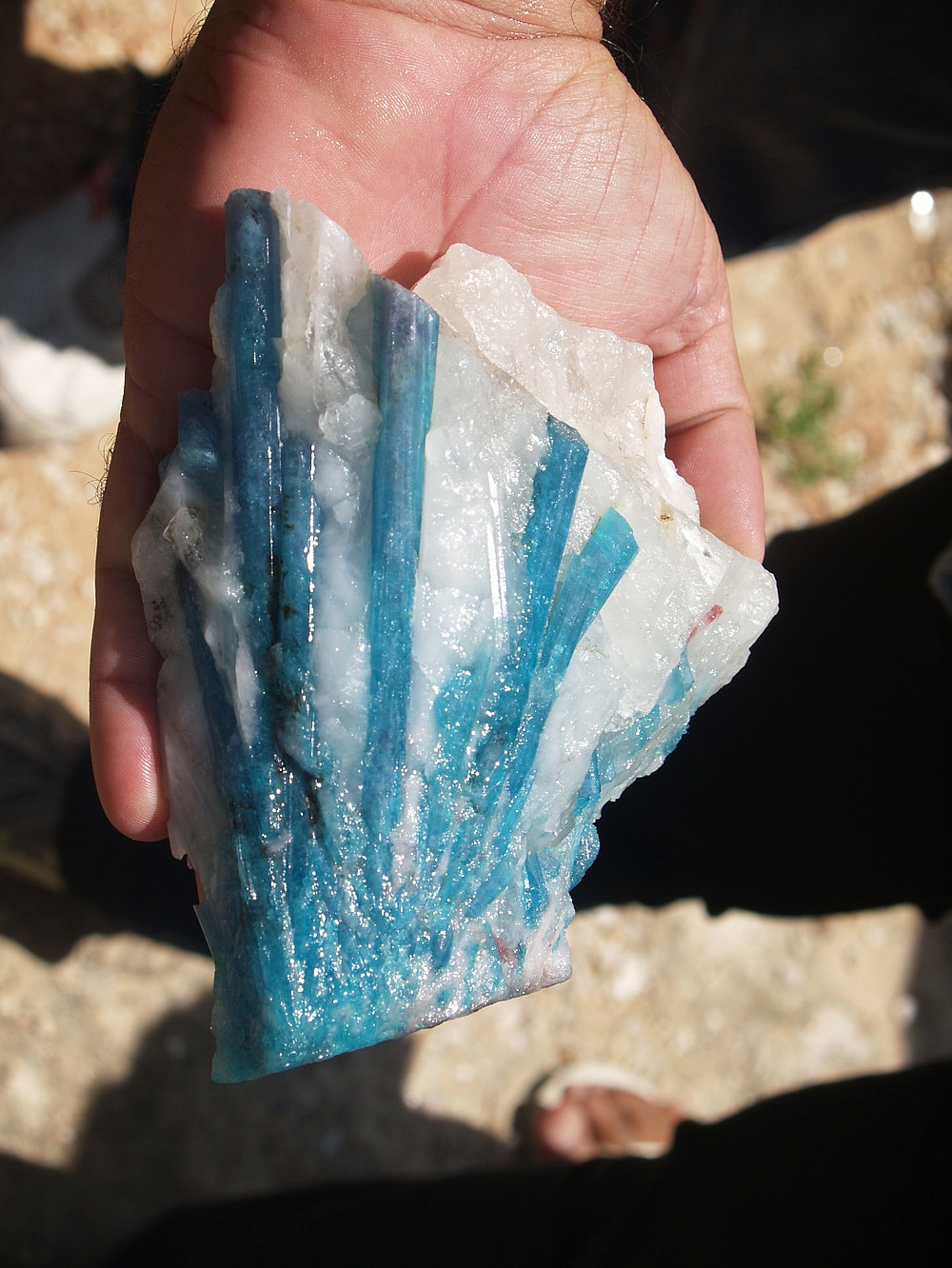
Pegmatites are remarkable coarse-grained igneous rocks which concentrate many of the critical materials that modern society depends on, including lithium, tin, tantalum, niobium, and rare-earth elements. These rocks form in the final, water-rich stages of magma cooling, when elements that don’t easily fit into common rock-forming minerals become highly concentrated. For geologists, understanding how pegmatites form is essential: it helps us predict where new deposits might be found, how large or enriched they may be, and how their metals are distributed within the rock. As demand for batteries, electronics, and green technologies continues to grow, improving our understanding of pegmatite formation directly supports the search for sustainable, responsible sources of critical raw materials. Furthermore, pegmatites are among the main sources of gemstone materials such as tourmalines, aquamarines and topaz.
To better understand how pegmatites form, I focused my Master’s project on one of their most abundant minerals—quartz—using tools like LA-ICPMS and FTIR. LA-ICPMS (Laser Ablation Inductively Coupled Plasma Mass Spectrometry) allows researchers to measure tiny amounts of trace elements inside quartz, revealing clues about the chemical environment during crystal growth. FTIR (Fourier-Transform Infrared Spectroscopy), on the other hand, detects different forms of water and water-related defects in quartz. Together, these methods help build a clearer picture of the temperatures, pressures, and fluid conditions that existed as pegmatites formed. These methods ultimately help us get a better understanding of how these pegmatites formed: where did the metals come from, how did the crystals grow, and what made certain pegmatites so unusually enriched in the materials we rely on today? Currently, I focus my attention on pegmatites from Elba island, Italy, and the Swiss Alps, as well as some other localities like Brazil and Afghanistan.
Mineral Evolution
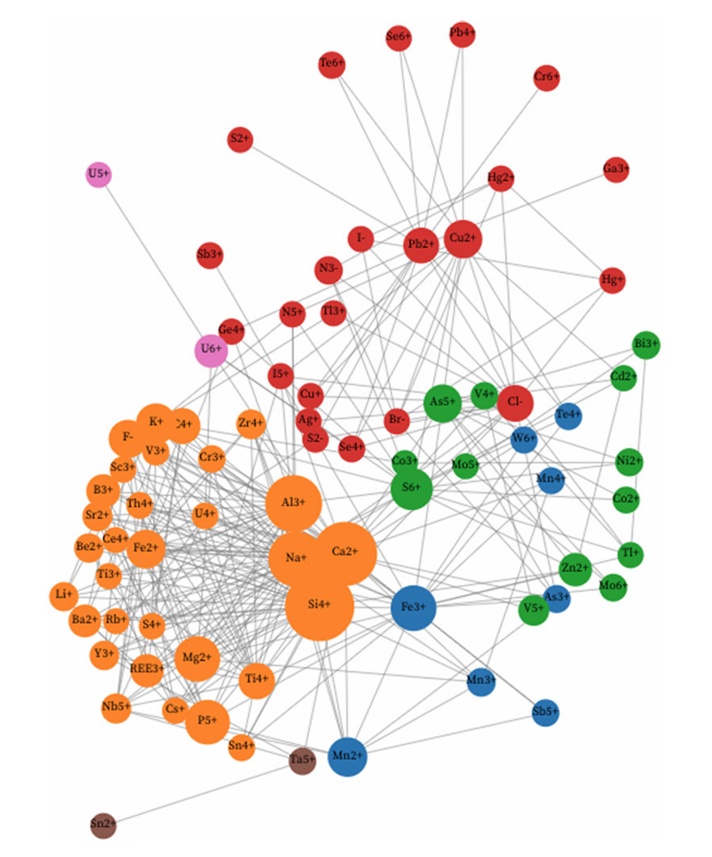
The theory of mineral evolution looks at all the minerals on Earth and asks a surprisingly simple question: Were all minerals always present on our planet? The answer is a clear no. The mineralogy of Earth—and of other planets and moons—has changed over billions of years. Physical, chemical, and even biological processes have transformed Earth’s surface and allowed new minerals to form with time. In this sense, just like life, the mineral diversity of our planet has evolved.
Since 2021, I have been working with the Carnegie Science team led by Prof. Bob Hazen to explore what minerals can teach us about Earth’s history. My research focuses on how average mineral properties—such as hardness or symmetry—have changed through geological time. We found that both hardness and symmetry tend to decrease over time because mineral structures and chemistries become increasingly complex. I have also contributed to developing a new Evolutionary System of Mineralogy, which expands mineral classification beyond chemistry and crystal structure. This new system also considers the processes and environments in which minerals form, allowing us to distinguish truly natural “kinds” of minerals in a way that reflects their origins and histories.
My ultimate goal in studying mineral evolution is to help bridge the gap between mineralogy and other Earth science disciplines. I want to highlight how much we can learn by studying Earth’s minerals as information-rich time capsules. I aim to drive a more unified effort in understanding how Earth materials form, transform, and interact.